Citation checker: catch fake DOIs before your professor does.
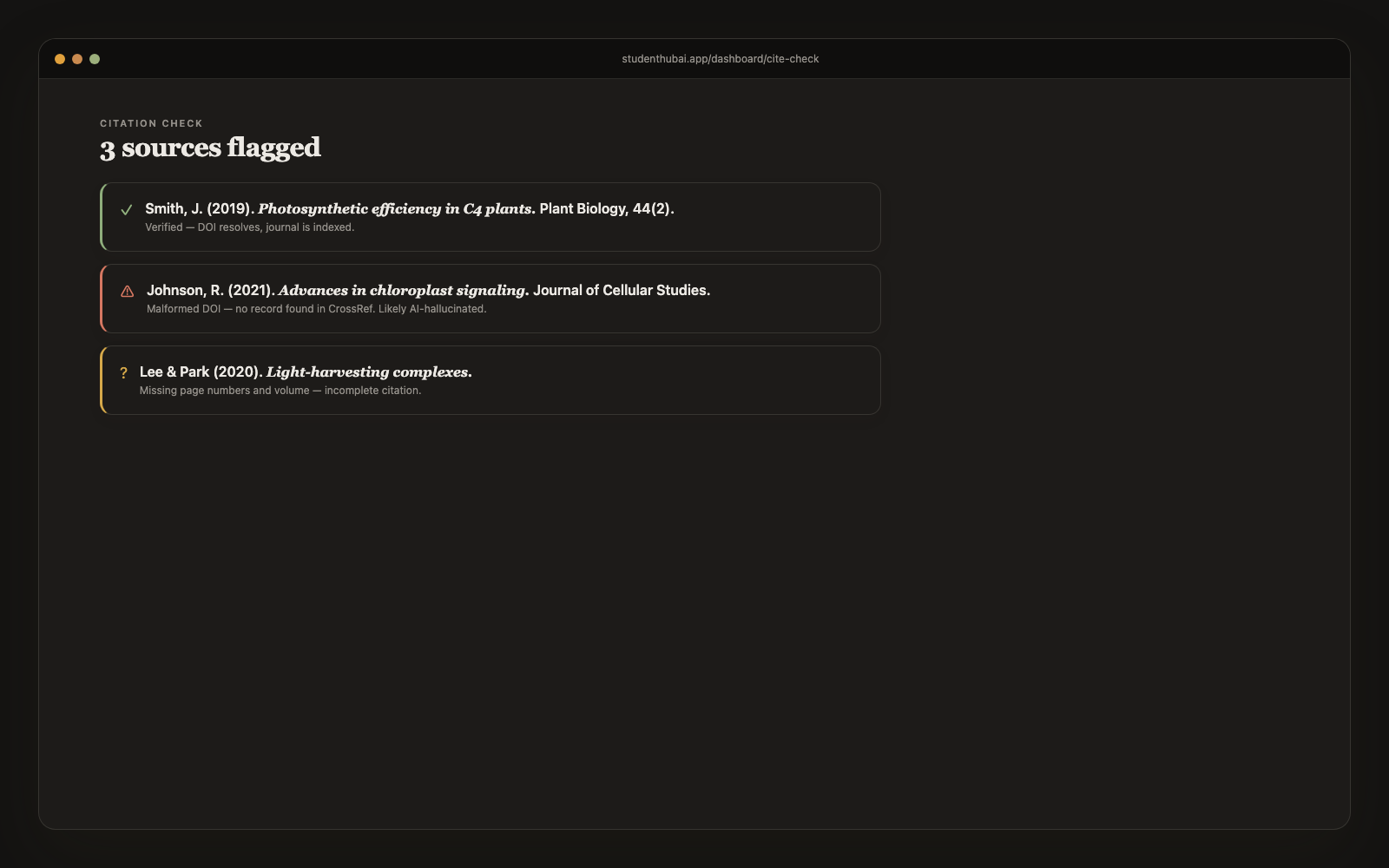
Paste your references list and AI verifies every citation. Flags fabricated journals (the kind ChatGPT invents), malformed DOIs, missing fields, and AI-hallucinated authors. Critical safety net for any paper using AI assistance.
Free plan · No credit card · This tool is a Pro feature
How it works
Three steps. Done in 60 seconds.
Paste your citations
Drop your references list: APA, MLA, Chicago, IEEE, whatever your prof requires. One per line.
AI verifies each one
Cross-references against real databases. Flags fabricated journals, malformed DOIs, missing fields, and suspicious patterns.
Fix or remove flagged sources
Per-citation status (verified ✓, needs review ⚠, fabricated ✗) with explanation. One-click Google Scholar / DOI lookup to find real replacements.
Why it works
Built for actual studying, not just demos.
Catches AI-hallucinated sources
ChatGPT and other LLMs frequently invent realistic-sounding citations that don't exist. We catch them.
Validates DOIs
Checks DOI format and pings doi.org to confirm the source exists. Catches malformed or fake DOIs.
Confidence-scored results
Each citation gets a confidence score (90+ = verified, 50-70 = needs review, <30 = likely fabricated) with reasoning.
Multiple formats supported
APA, MLA, Chicago, IEEE, Vancouver, plain bibtex, numbered lists, bullet lists, all parsed correctly.
Essay + sources mode
Paste an entire essay with inline citations and we verify every one. Useful for full paper review before submission.
Quick-action helpers
Per-citation "Search Google Scholar" and "Open DOI" buttons so you can find a real replacement in seconds.
vs alternatives
Why students switch to StudentHubAI
FAQ
Common questions
How reliable is the fake-citation detection?+
Every source gets checked in several ways: DOI format, a real lookup against the Crossref and PubMed registries, and a cross-check of the journal name. URLs are actually visited rather than judged on how plausible they look, which is what catches the invented ones. Results are confidence-scored so you know which to chase first.
Why are AI-invented citations such a problem?+
Because they look completely real. Language models produce plausible authors, believable journal names and DOIs with the right shape, and none of it exists. Grading software increasingly catches this, and by then it reads as fabrication rather than a mistake.
Which citation formats work?+
APA, MLA, Chicago, IEEE, Vancouver, numbered lists, bullet lists and plain text. The parser copes with the messy in-between versions too, which is what most bibliographies actually look like.
Can I check a whole essay with inline citations?+
Use Essay plus sources mode. It reads the essay, finds the inline citations, matches them against your reference list and verifies each one, so you also catch the reference you cited but never listed.
Does it handle websites and books?+
Peer-reviewed sources verify most confidently. Books and websites get partial verification, since we often can't confirm a specific edition or what a page said on the day you read it.
It flagged something I know is real. What now?+
Hit Recheck first, because a DOI server having a bad minute can cause a false flag. If it keeps failing, something in the citation is usually off by a little: wrong year, wrong journal, a digit out in the DOI.
How is this different from Turnitin?+
Turnitin asks whether you copied the text. We ask whether the sources exist at all. Those are different problems and in 2026 both of them matter.
Ready to make studying actually faster?
Free plan, no credit card. This tool is a Pro feature; the Free plan keeps your notes and calendar.
Start free →More study tools